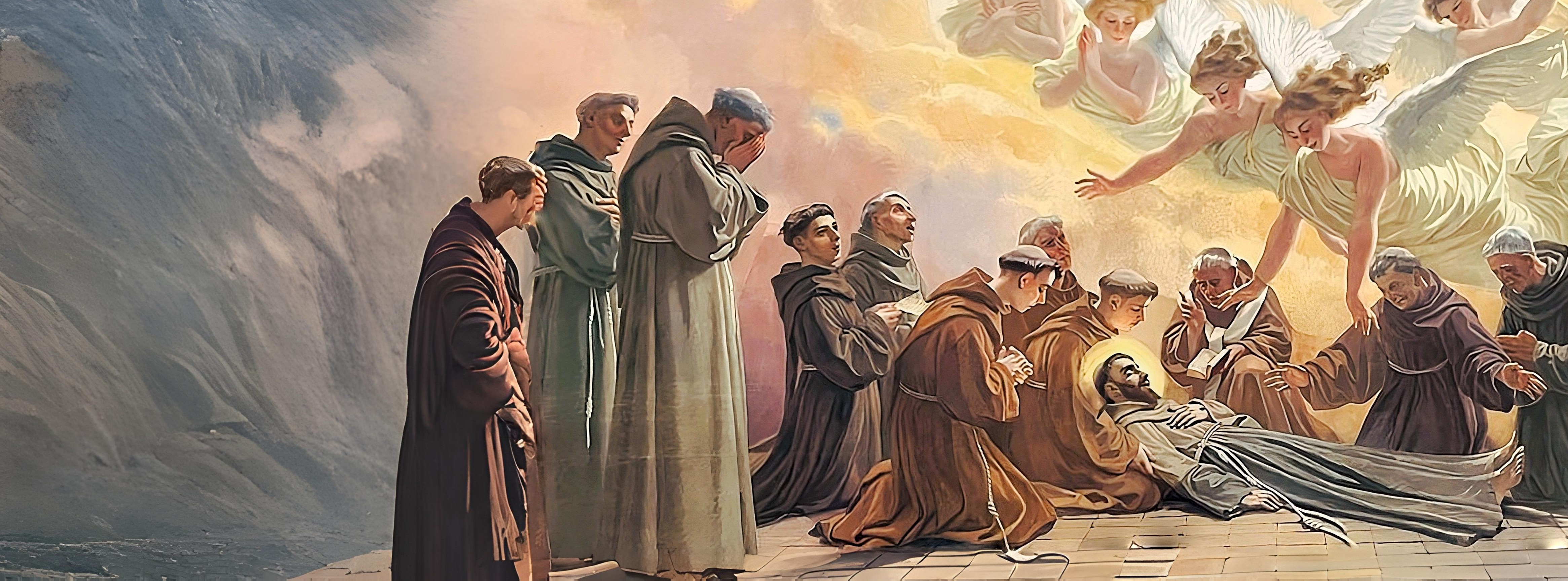
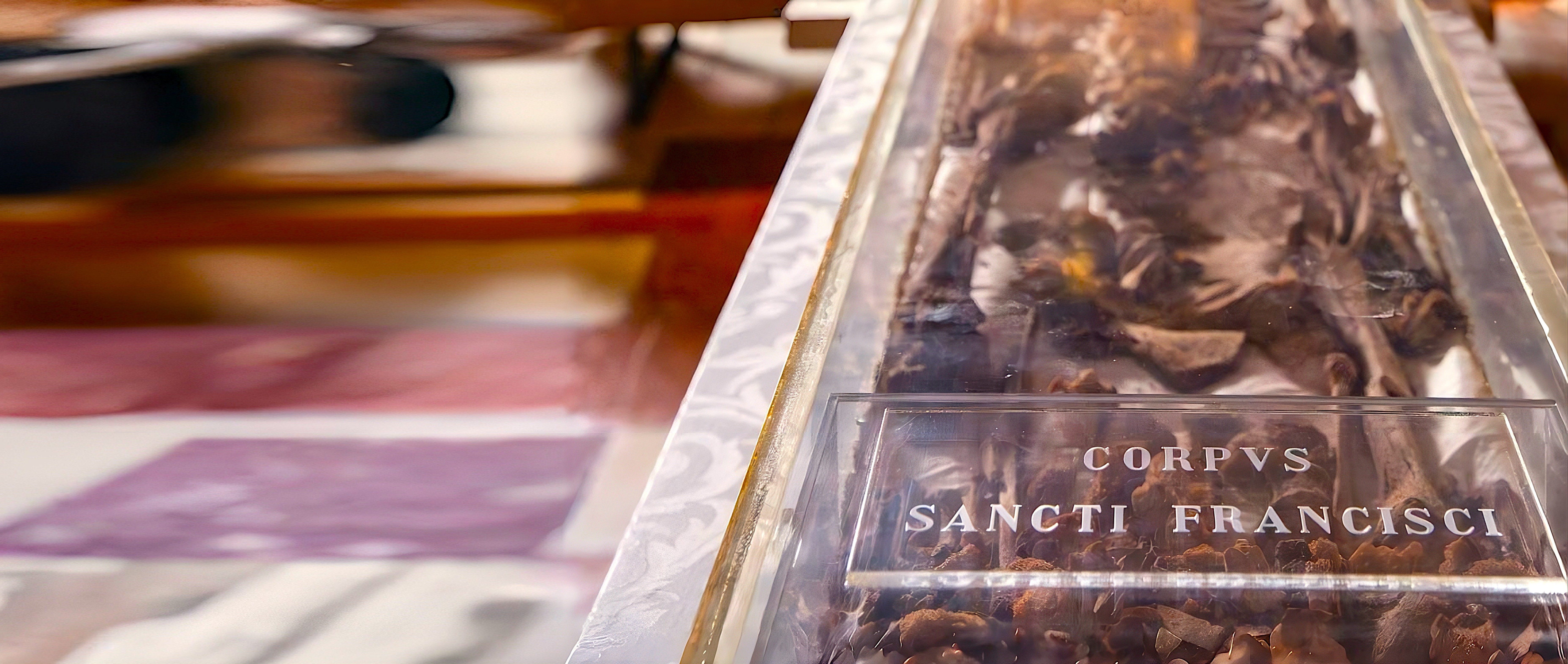


Eight hundred years after the death of St. Francis of Assisi (1226–2026), his body has been made visible to us again―not as an object of curiosity, but as a tangible presence that speaks to us.
On February 21, 2026, the first public and extended exposition of the mortal remains of St. Francis began at the Basilica of St Francis in Assisi. The event is part of the 800th anniversary commemorating his passing.
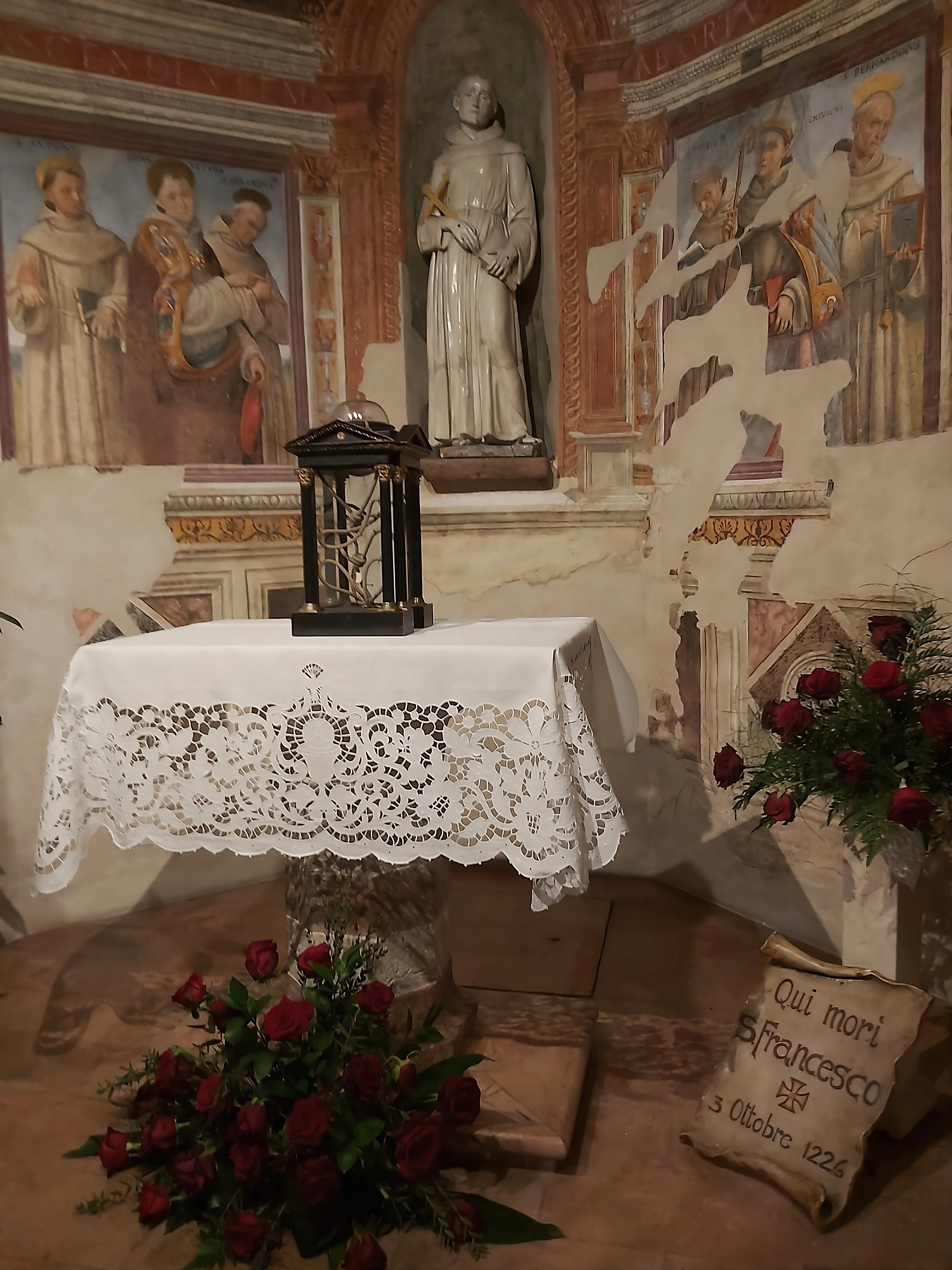
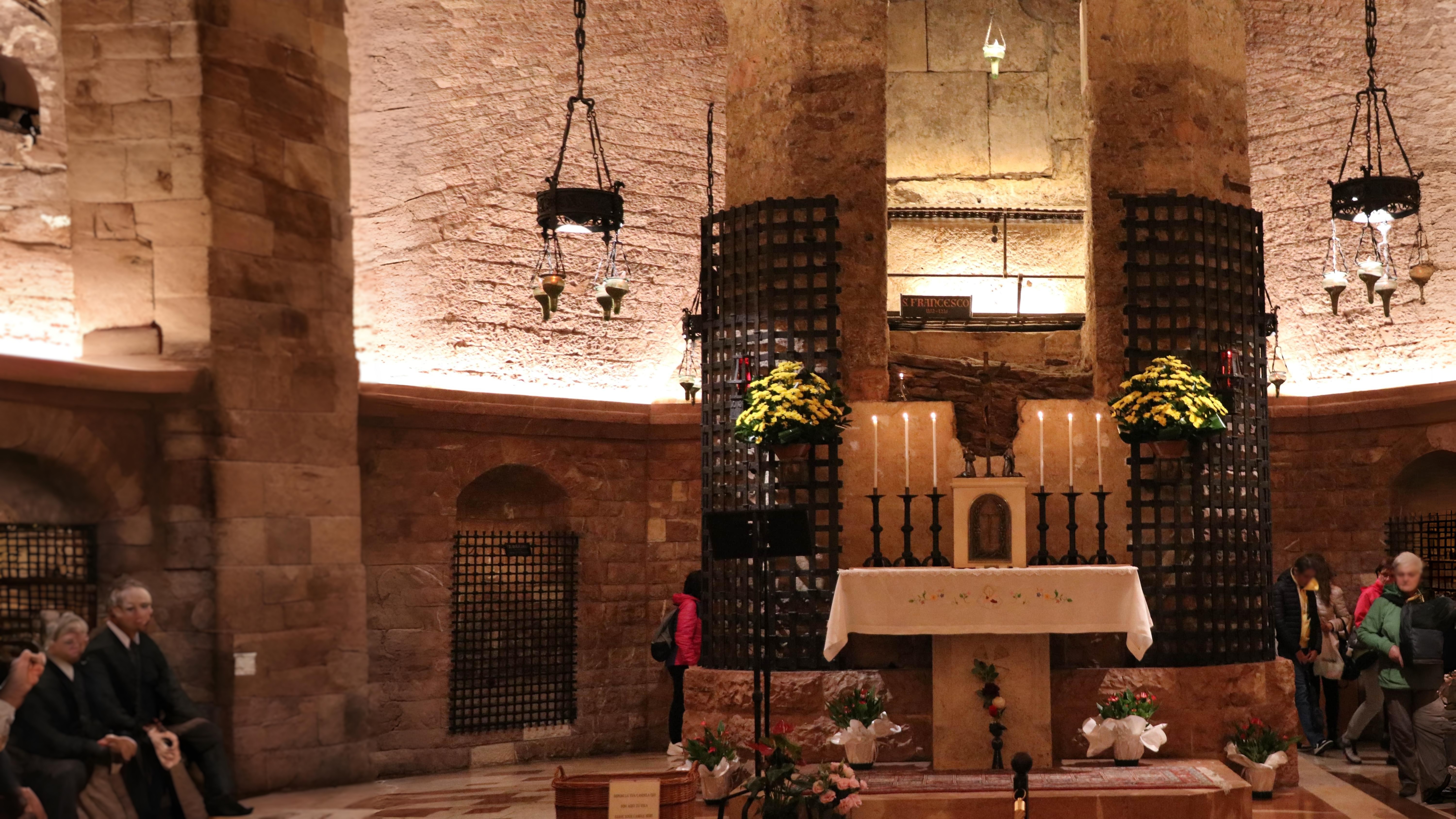
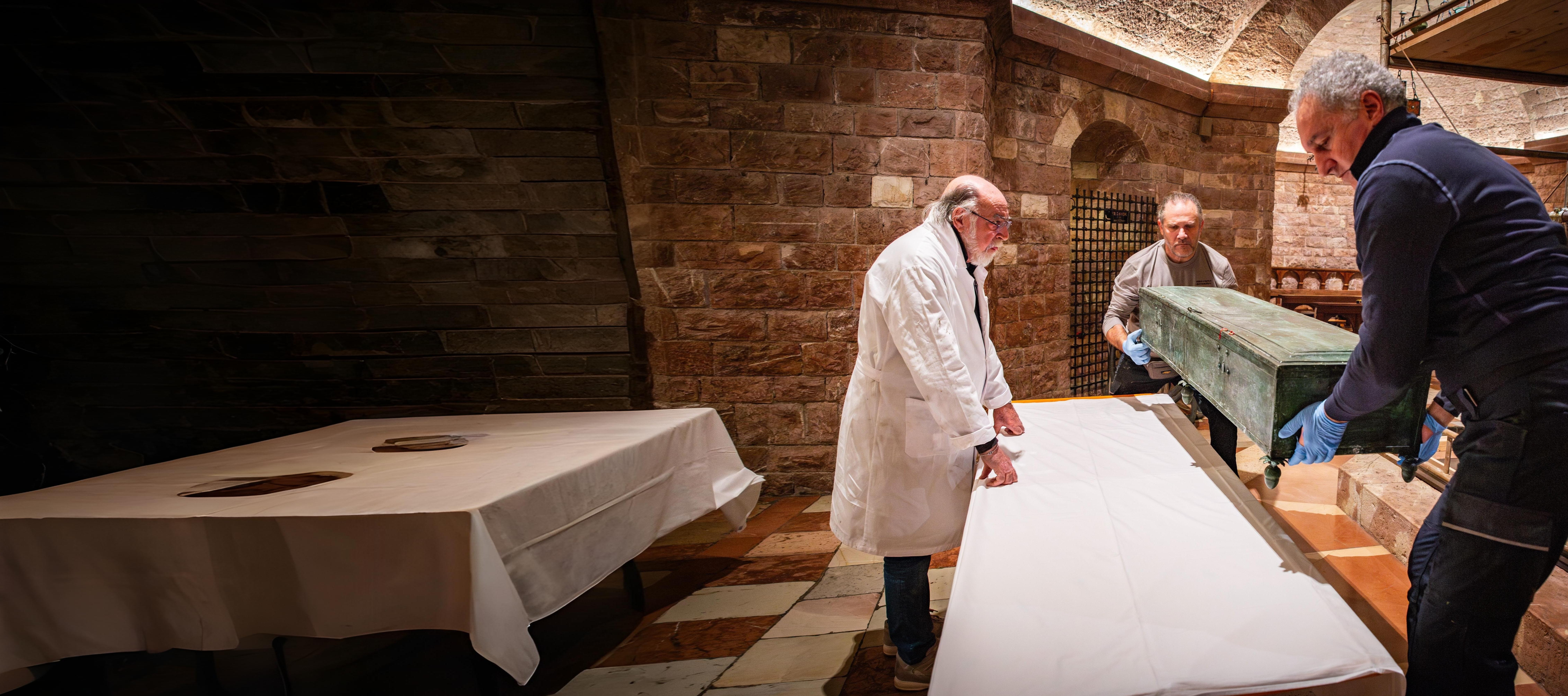
On the morning of February 21, Francis’ sarcophagus was reopened in the crypt of the basilica. Those who witnessed the event included His Eminence Cardinal Ángel FERNÁNDEZ ARTIME, Pontifical Legate for the Papal Basilicas of Assisi; the Most Reverend Domenico SORRENTINO, Archbishop Emeritus of Assisi–Nocera Umbra–Gualdo Tadino, (currently Apostolic Administrator); members of the Conventual Franciscan community; friars from the various families of the First Order and the Third Order Regular; religious sisters, lay persons; and members of the faithful. The opening was carried out simply and soberly, without fanfare, in the awareness of being in the presence of a living memory that touches the very roots of the Franciscan vocation. Revealing what had been preserved for centuries was not an aesthetic act; it was above all an ecclesial one. It engaged faith, memory, and tradition, while making our charismatic inheritance visible.
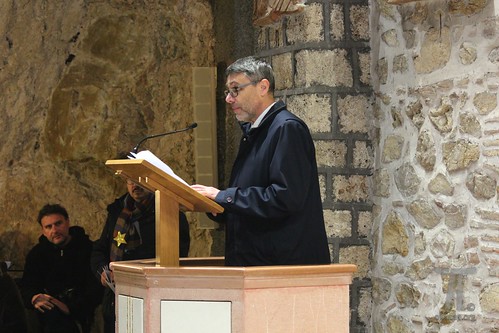
At noon, in the Cimabue Hall of the Colle del Paradiso Conference Center, religious and civil authorities were officially informed of the opening of the exposition. The exhibition was conceived in 2023 by the Custos of Assisi, Friar Marco MORONI, with the support of Archbishop SORRENTINO and encouragement from Pope Francis. It was formally authorized and blessed by Pope Leo XIV as part of the special Jubilee Year marking the Eighth Centenary of St. Francis’ passing.
At 4:00 p.m., the case was solemnly moved from the crypt to the lower church of the basilica, where it was placed at the foot of the papal altar in an atmosphere of prayer and reflection. Carried with great reverence by four friars, the procession was joined by Cardinal FERNÁNDEZ ARTIME, the attending Ministers General, the Custos of the Sacred Convent, and the friars responsible for liturgical service. It was a moving moment, giving visible form to the entrustment of the saint to the veneration of the People of God.
Next, Cardinal FERNÁNDEZ ARTIME presided over Evening Prayer, which was broadcast live during “A Sua Immagine,” a TV program on Rai1, Italy’s national public broadcasting network. That evening, the Basilica hosted a musical performance by the Schola Cantorum of the London Oratory School. In Assisi, it was clear that an extraordinary time was beginning.
On February 22, at 11:00 a.m., in the upper church of the basilica, Cardinal FERNÁNDEZ ARTIME presided over a Mass to inaugurate the exposition, which was again broadcast on Rai1. This began a full program of Masses that will conclude with a closing Mass on March 22 at 5:00 p.m. Cardinal Matteo Maria ZUPPI, Archbishop of Bologna and President of the Italian Bishops’ Conference, will preside. The Ministers General of the Friars Minor, the Conventual Franciscans, and the Capuchins are expected to attend, along with the Minister General of the Third Order Regular (TOR) and other Major Superiors. Together, they will offer a visible sign of unity as the entire Franciscan family, in all its different expressions, gathers around its founder.
From February 22 to March 22, 2026, the faithful may venerate the remains of the body of St. Francis now preserved in a transparent reliquary case in the lower church of the basilica. Access to the exposition is free, but reservations are required. This is to ensure an atmosphere of order and meditation. There are two ways to visit: a personal, silent visit, or a visit guided by a friar, which includes a brief lesson on the faith and a renewal of baptismal promises. Attendance is exceeding expectations; nearly 400,000 reservations have been made so far. It is projected that 700,000 pilgrims may visit over the course of the exposition. Around eighty percent of them are from Italy. Significant numbers are arriving from the United States, Croatia, Slovakia, Brazil, France, the United Kingdom, Indonesia, Japan, Kenya, Jamaica, and Singapore. More than four hundred volunteers—members of more than sixty church and civic organizations, mostly women—are assisting the friars. Ninety religious are steadily engaged in service, with additional reinforcements arriving specifically for this event.
The exposition takes place during Lent. This is no minor detail. Lent reminds us that we are limited, fragile, dust. Francis’ body was slight in stature and marked by illness and hardship. Yet it speaks paradoxically in a culture that values appearances. It does not impress by grandeur or physical perfection, but by the coherence of his life and his radical commitment to the Gospel. For many, standing before his bones is a moment to rethink the meaning of their own life and faith.
The word that captures this is “evangelical”: “Unless a grain of wheat falls to the ground and dies, it remains just a grain of wheat; but if it dies, it produces much fruit” (Jn 12:24). The exposition does not invite nostalgia; it calls for reflection. What remains of a life held back? What blossoms from a life freely given?
That we can celebrate this month of veneration today is the result of a long and carefully curated history. St. Francis died in 1226. In 1230, his body was placed in the new basilica and hidden with extraordinary protective measures to prevent theft. It remained hidden for centuries. On December 12, 1818, after weeks of excavations authorized by Pope Pius VII, the tomb was rediscovered. A crypt was constructed in the nineteenth century to allow for orderly veneration by the faithful.
In 1978, Pope Paul VI authorized an official scientific examination of the remains. Under the direction of Professor Nicolò Valentino MIANI, concrete data was obtained: Francis was slight in stature, approximately 1.57–1.58 meters (5 feet, two inches) in height. He had deformities in the bones of his feet consistent with prolonged suffering. On that occasion, his remains were placed in a sealed, climate-controlled case, with oxygen replaced by nitrogen to ensure long-term stability. Further examinations in 1994 and 2015 confirmed the effectiveness of the system and the good preservation of the remains. The 2026 exposition rests on this solid scientific foundation.
Preparation for this month of exposition has been extensive: reception structures have been built in the square, there is coordination between civil and religious authorities, and a civil protection plan has been implemented to suit the expected number of visitors. The Italian Region of Umbria is supporting the Eighth Centenary with specific legislative measures, and authorizing a “landmark project”: the creation of a special hospice for children with cancer within the regional palliative care network. The project will be funded by donations collected during the exposition.
Alongside the daily liturgical celebrations, the month of veneration includes gatherings for young people, prayer sessions dedicated to particular groups, cultural and musical events, and tours of the city’s Franciscan sites. Assisi has become more than a tourist destination; the exposition has made it a true place of pilgrimage.
It has been announced that Pope Leo XIV will visit Assisi during the “GO! Franciscan Youth Meeting,” scheduled for August 3-6, 2026. Young people aged 18-33, coming from countries all over Europe, will gather in Assisi for four days of formation, prayer, and encounter. This event, which is part of the Eighth Centenary, is not centered on the past but is a living experience that continues to shape the future.
Francis body is not on display to honor his death. Rather, his body shows a history of faithfulness. Francis still speaks—not because his bones were preserved, but because his life was fully given. Even eight hundred years later, this remains the decisive truth.
Friar Alejandro Palacios Vázquez, OFMConv